 Scholarships
Chevening Scholarship 2027–28: Deadline, Eligibility and How to Apply
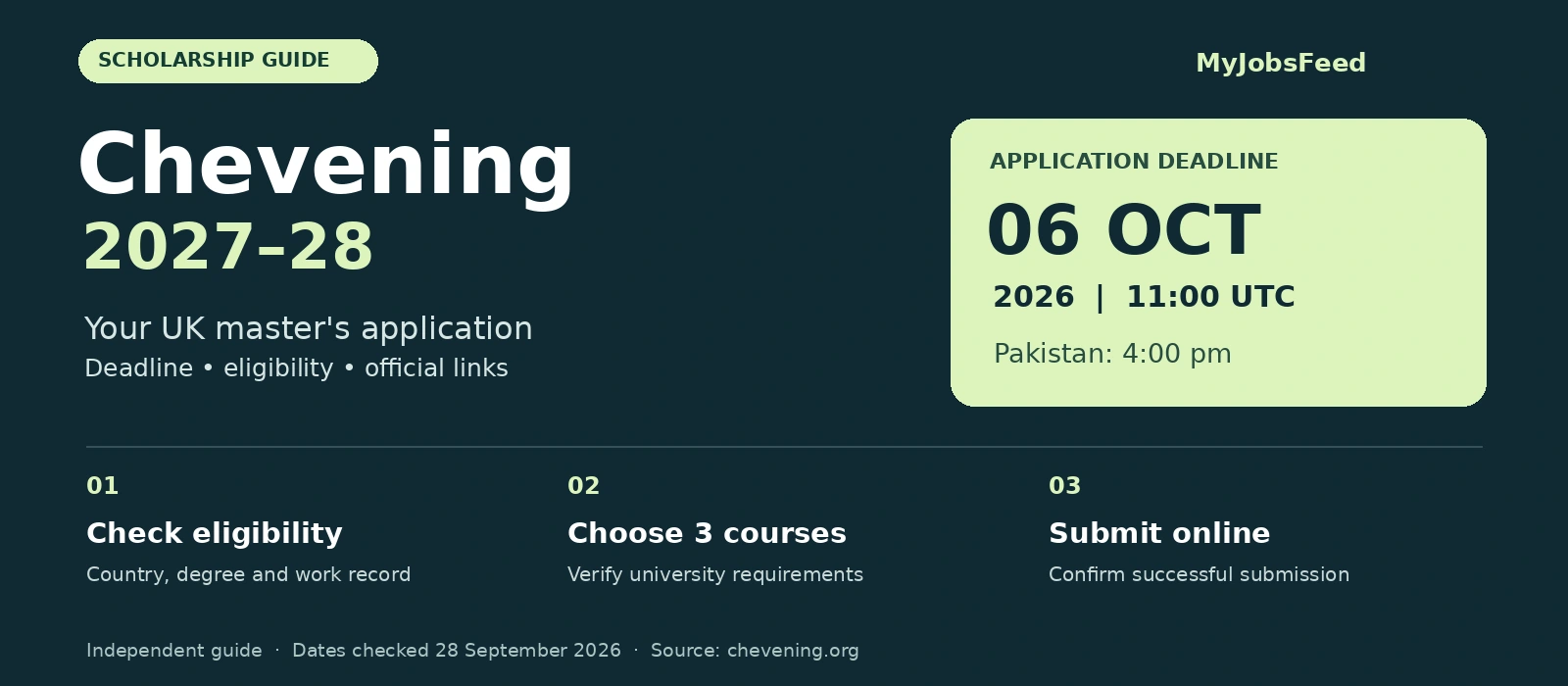
Verified on 28 September 2026. Chevening Scholarship applications for the 2027–28 academic year are open, with a deadline of 6 October 2026 at 11:00 UTC. That is 4:00 pm in Pakistan. The official timetable places the start of studies in September or October 2027, so this application round is for next year's intake.
Chevening supports eligible international applicants pursuing a one-year master's degree in the UK. Before spending the remaining days on an application, check three things: your citizenship and residence, your post-degree work experience, and whether your chosen courses qualify. A strong academic record alone does not replace those requirements.
Find your country or territory's official award page and use its application link. Pakistani applicants can go directly to Chevening in Pakistan, which confirms the same closing date.
Chevening 2027–28: key dates
Stage | Official timing |
|---|---|
Scholarship application deadline | 6 October 2026, 11:00 UTC |
Interview shortlisting | Mid-February 2027 |
Interviews | March–April 2027 |
Results begin | Mid-June 2027 |
Unconditional university offer deadline | 8 July 2027, 17:00 BST |
Studies begin | September/October 2027 |
These dates come from the official scholarship timeline. Fellowship schedules differ. Set your own submission target earlier than the closing time so that connection problems or a missing detail do not become a last-minute emergency.
Who can apply?
The main eligibility checks are:
Citizenship of an eligible country or territory, plus applicable residence requirements. Applicants for an ODA-eligible country award must reside in an ODA-eligible country.
An undergraduate qualification suitable for admission to a UK master's course, completed at least two years before the application deadline.
At least 2,800 hours of qualifying work after completing that degree, acquired over a minimum of two years.
Three eligible UK course choices, with at least one unconditional offer secured by the later offer deadline.
A commitment to return to the country of award for at least two years after the scholarship.
The full eligibility rules also cover exclusions involving British citizenship, UK residence, certain employment and family connections, and previous UK government-funded study. Read them before applying; this checklist is a starting point.
Which work experience counts?
Chevening accepts qualifying full-time or part-time employment, volunteering, and paid or unpaid internships. Its work-experience guidance specifies that the experience must follow completion of your undergraduate degree. For this cycle, it says applicants must have completed their degree by October 2024; check your exact completion date against the two-year rule.
The form calculates hours from weeks worked multiplied by weekly hours, and allows up to 15 employment periods. Prepare a record of each role's dates and actual weekly hours. Do not assume that the length of time since graduation automatically proves you meet the hours requirement.
A useful self-check: put your degree completion date at the top of a worksheet, then list the work periods that followed it. Review overlapping roles carefully and use accurate hours. This makes gaps or mistaken dates easier to catch before entering the form.
What does the scholarship cover?
Chevening describes the award as fully funded. Its funding summary lists tuition support, approved economy travel, the scholar's visa application cost, arrival and departure allowances, and a monthly allowance for accommodation and living expenses. The stipend differs according to whether you study in London and is reviewed annually; do not build a budget around an old social-media figure.
Check exceptions before committing money. The course guidance states an MBA tuition cap of £22,000 and says Chevening does not pay university tuition deposits. It also describes possible course changes or a contribution where a university does not provide its tuition discount. Travel and visa provisions listed for the scholar should not be treated as family funding.
How to choose your three courses
Eligible courses are normally full-time, UK-based taught master's programmes lasting nine to twelve months and starting in autumn. Part-time, distance-learning, PhD and research-focused MRes programmes do not qualify. Use the official course guidance and course finder, then check each university's own admissions page.
Listing courses on Chevening is not a university application. Apply separately to the universities and track their individual deadlines. You can submit the scholarship application before applying to the courses.
For your own comparison, make three columns: skills the course teaches, entry requirements you meet, and the university deadline. Read the module list rather than choosing by university name alone. A course that fits your proposed work after graduation is easier to explain convincingly.
How to submit your Chevening application
Open your country's award page and follow the official application link.
Register with your email and mobile number, complete the eligibility checker, and keep your unique access code secure.
Enter your personal, education and work details; add your three course choices and two referees' details.
Answer the four application questions in English, observing the limits shown in the form.
Save progress as you work. Review all sections before submitting and confirming submission.
Look for the successful-submission notice and confirmation email. A saved application is not a submitted one.
The application-system guide explains these steps and says applications cannot be edited after submission. Reference letters are required later if you reach interview, rather than being the same thing as entering referee contact details now.
Prepare evidence, not a generic essay
Chevening assesses leadership, professional relationships, course choice and career plans. Its application criteria ask for concrete outcomes and a realistic plan for future impact. The course answer should focus on your first choice while showing you have researched the options.
For your own preparation, write down what happened, what you personally did, what changed, and what you learned. Replace broad claims such as being a strong leader with an experience you can explain honestly at interview. Only include figures you can substantiate.
Write the answers yourself. Chevening prohibits AI-generated application answers and plagiarism. It also states that applying is free and that it does not endorse paid third-party application support. This article explains the process; it is not an application-answer template.
Frequently asked questions
Is Chevening only for Pakistani applicants?
No. The programme serves eligible countries and territories internationally. Start with the award page for your citizenship and check the residence rules. Pakistan has its own official country page.
Is there an upper age limit?
Chevening's who-can-apply guidance says there is no upper age limit. The qualification, work-experience and other eligibility conditions still apply.
Does an existing master's degree disqualify me?
No. The eligibility guidance permits applicants who already hold a master's degree, subject to the other rules, including restrictions on previous UK government-funded study.
Where should I start today?
First check eligibility. Then verify three course choices and prepare your work record, referee details and your own written answers. Save time for one final review of names, dates, course titles and submission status.
Explore more opportunities through MyJobsFeed Scholarships. This is an independent MyJobsFeed guide, not an official Chevening announcement. The linked official pages govern eligibility and deadlines; recheck them before submitting.